

Introduction
Geometry Learn V4 is a modern approach designed to make geometry easier, clearer, and more engaging for learners of all levels. Unlike traditional methods that rely heavily on memorization, this system focuses on interactive geometry learning, helping students understand concepts through visualization and practice.
With the support of visual geometry concepts, learners can explore shapes, angles, and measurements in a more meaningful way. It also integrates digital geometry tools to enhance understanding and improve retention. By combining geometry problem solving techniques with spatial reasoning skills, Geometry Learn V4 transforms complex topics into simple, practical learning experiences that build confidence and long-term understanding.
Introduction to Geometry Learn V4
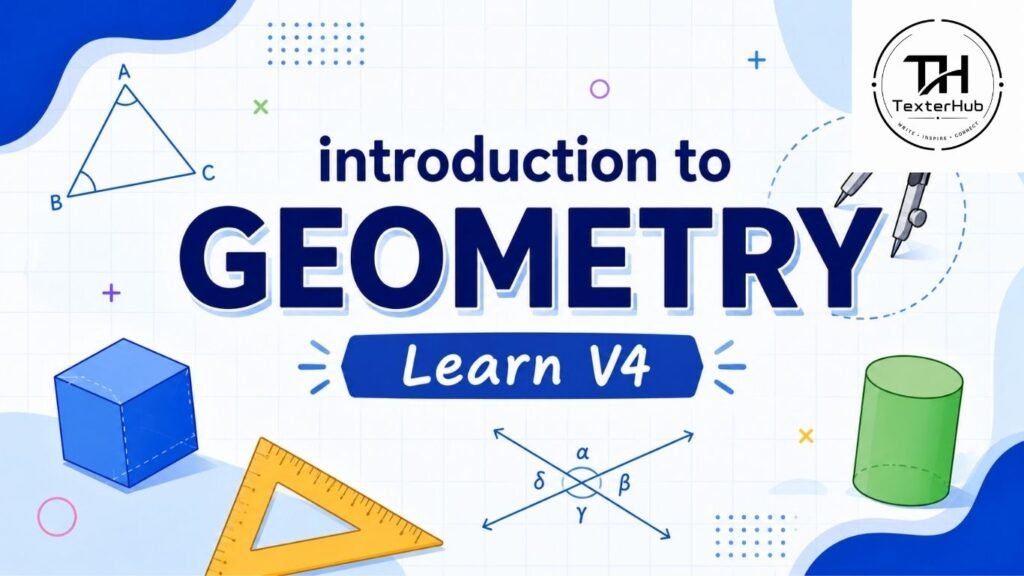
So what exactly is Geometry Learn V4? Think of it as a fresh take on a subject that’s been taught the same way for decades. It’s a modern learning system designed to make geometry finally click, even for people who’ve struggled with it their whole lives. Instead of dry textbooks filled with flat diagrams and walls of text, it uses visual geometry concepts to show you exactly what’s happening in real time. You don’t just read about a triangle rotating—you see it rotate. You don’t just memorize what an angle looks like—you watch it form, degree by degree, right in front of you.
This shift matters more than it might seem. For a lot of learners, geometry has always felt disconnected from reality. Numbers and rules on a page, with no clear link to anything tangible. Geometry Learn V4 closes that gap. Shapes move. Angles bend and stretch. Coordinate points shift across a grid as you drag them. Suddenly, nothing feels abstract anymore. It feels like something you can touch, manipulate, and understand from the inside out.
This guide is for everyone, and that’s not just a friendly line—it’s genuinely built that way. Parents searching for better resources for geometry for students will find clear explanations they can actually follow themselves, which makes helping with homework a lot less stressful. Teachers exploring new geometry learning methods will see how interactive tools can supplement or even replace some of the repetitive drills that often leave students checked out. And learners who just want geometry explained easily, without jargon or unnecessary complexity, will find that here too.
What Makes Geometry Learn V4 Different from Traditional Methods
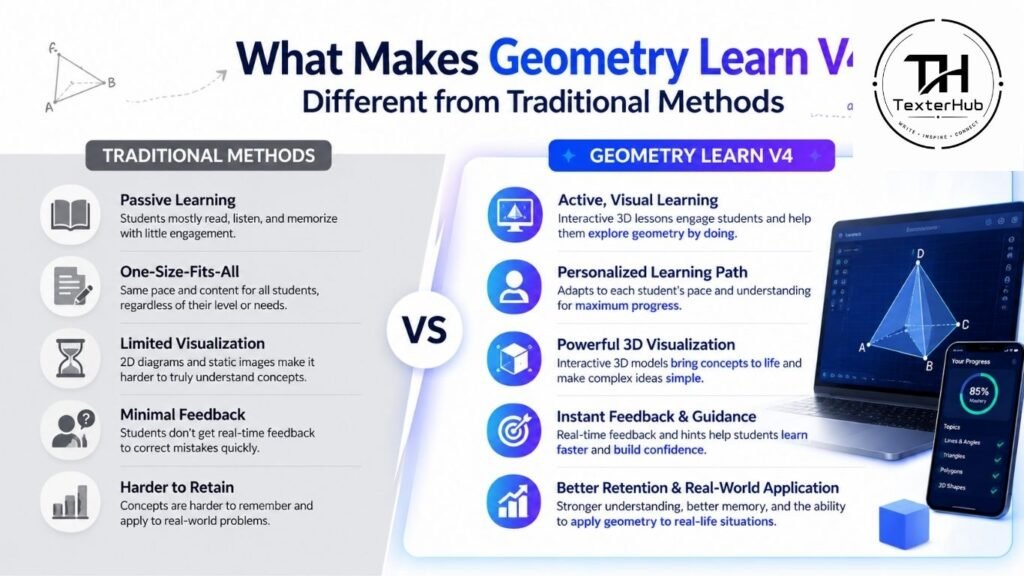
Old-school geometry classes relied on static diagrams and repetitive drills, the kind that show up on a worksheet, get copied into a notebook, and then quietly disappear from memory a week later. You’d memorize a formula, plug in numbers, and move on to the next problem without much thought. The process felt more like following a recipe than actually learning. But did you understand why the formula worked in the first place? Probably not. And that’s the real problem with traditional geometry instruction—it teaches the “what” without ever explaining the “why.”
Geometry Learn V4 flips that script completely. Instead of static pictures that never change, it uses digital geometry tools that respond to your actions in real time. Drag a vertex, and the whole shape adjusts instantly. Change an angle, and you watch every related measurement update right before your eyes. This kind of immediate cause-and-effect feedback helps the “why” finally make sense, because you’re not just told a rule—you’re watching it happen, over and over, until it becomes intuitive.
Here’s the kicker, though, and it’s the part that really sets this platform apart: it adapts to you. It notices where you struggle, whether that’s calculating area, identifying angle types, or working through coordinate geometry problems. Then it adjusts the pace accordingly, slowing down on tricky concepts and speeding through ones you’ve already mastered. That’s the best way to understand geometry—by learning at your own speed, not someone else’s, and definitely not at the pace dictated by a thirty-student classroom where the teacher has to keep moving regardless of who’s keeping up.
How Geometry Learn V4 Adapts to Different Learning Styles
Not everyone learns the same way. Some people need pictures. Others need to move things around with their hands (even virtually). Geometry Learn V4 supports visual, auditory, and hands-on learners through self paced learning in mathematics. You choose how you absorb information, and the platform meets you there.
Basic Concepts of Geometry (Points, Lines, and Planes)
Before tackling shapes, you need the building blocks. A point is just a location—no size, no width, nothing. A line is a straight path that goes on forever in both directions. A plane is a flat surface that stretches infinitely, like an endless tabletop.
These might sound simple, but they’re the foundation of everything else. Geometry concepts for beginners always start here. Think of a point as a single star in the night sky. A line is like a laser beam shooting across a room. A plane is the floor of a giant warehouse with no walls. Geometry Learn V4 brings these ideas to life with moving visuals, so they stick.
Understanding 2D and 3D Shapes
Shapes are everywhere. Look around your room right now—you’ll spot circles, rectangles, and triangles without even trying. 2D and 3D shapes learning is where geometry starts feeling real. Two-dimensional shapes have length and width but no depth: think squares, triangles, and circles. Three-dimensional shapes add depth: cubes, spheres, cylinders, and pyramids.
Geometry Learn V4 uses rotating 3D models you can spin and explore from every angle. Instead of imagining a cube on paper, you actually see all six faces. This kind of math visualization technique helps learners grasp depth and structure way faster than flat drawings ever could.
| Shape Type | Examples | Key Feature |
| 2D Shapes | Square, Triangle, Circle | Flat, two dimensions |
| 3D Shapes | Cube, Sphere, Cone | Solid, three dimensions |
Properties of Shapes and Their Formulas
Every shape has its own personality—its own set of properties. Triangles have three sides and three angles that always add up to 180 degrees. Circles have a radius, diameter, and circumference. Squares have four equal sides and four right angles. Knowing these properties is half the battle.
Then come the formulas. Easy geometry formulas with explanation make life so much simpler once you understand the logic behind them. Here’s a quick cheat sheet:
| Shape | Formula | What It Calculates |
| Square | Area = side × side | Area |
| Triangle | Area = ½ × base × height | Area |
| Circle | Circumference = 2 × π × radius | Perimeter |
| Cube | Volume = side³ | Volume |
Geometry Learn V4 doesn’t just hand you these formulas. It shows you why they work, step by step, using geometry problem solving exercises built right into the lessons.
Types of Angles and Their Real-Life Importance
Angles are sneaky. They’re everywhere, but most people don’t notice them. There are five main types: acute (less than 90 degrees), right (exactly 90 degrees), obtuse (more than 90 but less than 180), straight (exactly 180), and reflex (more than 180). Each one shows up in daily life more than you’d think.
A door opening is an angle. A ramp leading into a building is an angle. Even the hands on a clock form angles every second. Shapes and angles learning isn’t just academic—it’s practical. Architects use angles to design stable buildings. Athletes use angle awareness to improve their swing or throw. Understanding angles sharpens your eye for the world around you.
Common Angle Mistakes Students Make
A lot of learners mix up complementary angles (adding to 90 degrees) with supplementary angles (adding to 180 degrees). Others struggle reading a protractor correctly, often starting from the wrong zero mark. Geometry Learn V4 includes quick practice drills that catch these errors early, before they become bad habits.
Measurement in Geometry (Area, Perimeter, and Volume)
Measurement is where geometry meets the real world. Area tells you how much surface a shape covers—think flooring for a room. Perimeter is the distance around a shape’s edge—like fencing for a backyard. Volume measures how much space a 3D object holds—think water filling a tank.
These three concepts pop up constantly in everyday tasks. Painting a wall? You need area. Building a garden fence? Perimeter. Filling a fish tank? Volume. Geometry practice exercises inside Geometry Learn V4 turn these calculations into interactive challenges, so you’re not just memorizing—you’re applying.
Coordinate Geometry and Graph Analysis
Ever used a map app to find directions? That’s coordinate geometry in action. Coordinate geometry basics start with the coordinate plane: a horizontal x-axis, a vertical y-axis, and four quadrants where they meet. Every point on this grid has an address—an (x, y) pair.
From there, you learn to plot points, measure distance between them, and calculate slope (how steep a line is). Geometry Learn V4 offers interactive graphing tools that let you drag points and watch the math update instantly. This hands-on approach makes abstract numbers feel concrete, especially for learners who struggle with traditional graph paper.
Transformations in Geometry (Rotation, Reflection, Translation)
Transformations describe how shapes move without changing their size or form. Rotation spins a shape around a fixed point, like a wheel turning. Reflection flips a shape across a line, just like your image in a mirror. Translation slides a shape from one spot to another, no flipping or turning involved.
These ideas show up in animation, video games, and even dance choreography. Geometry Learn V4 animates each transformation step by step. You watch a triangle rotate in real time, or see a square slide across the screen. This kind of visual learning in education makes abstract motion easy to follow and remember.
Symmetry and Patterns in Geometry
Symmetry is everywhere, and once you start noticing it, you can’t stop. Line symmetry means one half of a shape mirrors the other. Rotational symmetry means a shape looks the same after spinning it partway around. Tessellations are patterns made of repeating shapes that fit together perfectly, like tiles on a floor.
Nature loves symmetry. Snowflakes, leaves, and even human faces show it. Architecture uses symmetry for balance and beauty—think of famous buildings with matching wings. Geometry Learn V4 includes symmetry exercises that train your eye to spot these patterns, building intuition that helps with geometry problem solving down the road.
Symmetry in Everyday Objects
Take a look around. A butterfly’s wings mirror each other. A stop sign has rotational symmetry. Even your dinner plate is symmetrical. Once you start spotting symmetry, you’ll see it in places you never expected.
Interactive Geometry Learning and Digital Tools
Textbooks are static. They show one picture and expect you to imagine the rest. Interactive geometry learning flips that completely. With apps, simulations, and even augmented reality, learners can manipulate shapes directly, watching changes happen instantly.
Geometry Learn V4 stands out among online geometry learning platforms with features like drag-and-drop shapes, instant feedback on practice problems, and animated explanations for tricky concepts. How digital tools improve math learning comes down to one thing: engagement. When you’re actively doing something, you remember it better than when you’re just watching or reading.
Problem-Solving Techniques for Geometry Students
Geometry problems can feel overwhelming, especially word problems. But there’s a simple method that works every time. First, read the problem carefully. Then sketch a diagram if one isn’t given. Next, identify what you know and what you need to find. Finally, choose the right formula and solve.
Tips to solve geometry problems faster often come down to practice and pattern recognition. The more problems you work through, the more familiar the patterns become. Geometry Learn V4 breaks complex problems into smaller, manageable steps, so you never feel stuck or lost. Step by step geometry learning turns intimidating problems into simple sequences.
Real-World Applications of Geometry
Geometry isn’t just something you study and forget. Real life uses of geometry are everywhere, from careers to everyday chores. Architects design buildings using geometric principles. Engineers calculate stress and load using shapes and angles. Game designers build virtual worlds using 3D geometry. Even fashion designers use geometric patterns for clothing.
On a smaller scale, geometry helps with home renovation projects, cooking measurements, and sports strategy. Geometry applications in real life prove that this subject isn’t just for the classroom—it’s a life skill. Understanding shapes and space helps you make better decisions every single day, whether you realize it or not.
Benefits of Learning Geometry with Modern Methods
Why does modern math learning matter so much? Because the benefits go far beyond passing a test. Students who use interactive tools show geometry skills improvement much faster than those using only textbooks. Visualization helps concepts stick in long-term memory, not just for the next quiz.
Benefits of interactive learning in math also include reduced anxiety. When students see concepts instead of just reading about them, math feels less scary. Geometry Learn V4 supports all of this by combining visuals, practice, and instant feedback into one smooth experience. As one teacher put it: “My students used to dread geometry. Now they actually ask for more practice time.”
The Future of Geometry Education
Where is geometry education headed? The short answer: more personalized, more visual, and more immersive. Artificial intelligence is already helping platforms adjust lessons based on individual progress. Augmented reality and virtual reality are starting to bring 3D shapes into physical classrooms, letting students “hold” a cube in their hands through a headset.
Gamification is another big trend—turning practice problems into challenges with points and rewards. How to build strong math foundation in the next decade will likely involve a mix of AI tutoring, immersive visuals, and self paced learning in mathematics. Platforms like Geometry Learn V4 are leading this shift, setting the standard for what modern geometry education should look like.
Conclusion
Geometry doesn’t have to be the subject everyone dreads. With the right tools and approach, it can actually be fun—even exciting. We’ve covered the basics: points, lines, shapes, angles, measurements, and transformations. We’ve explored geometry course online options and how geometry for kids and adults can benefit from interactive learning.
Geometry Learn V4 brings all of this together in one place. It’s built for spatial reasoning skills, packed with geometry practice exercises, and designed to make learning feel natural, not forced. If you’ve been searching for how to learn geometry easily, this might be exactly what you need. Give it a try, and watch your confidence grow.
FAQs
1. What is Geometry Learn V4?
Geometry Learn V4 is a modern learning approach that uses visual and interactive methods to make geometry easier to understand.
2. Is Geometry Learn V4 suitable for beginners?
Yes, it is designed for all levels, especially beginners who need clear and simple explanations.
3. How does Geometry Learn V4 improve learning?
It uses visuals, practice, and digital tools to help students understand concepts better and faster.
4. Can it help in exams?
Yes, it strengthens concepts and problem-solving skills, making exam preparation easier.
5. Does it include real-life applications?
Yes, it connects geometry concepts to real-world uses like design, construction, and technology.
6. Is Geometry Learn V4 self-paced?
Yes, learners can study at their own speed and revisit topics anytime.
7. What topics are covered in Geometry Learn V4?
It covers shapes, angles, coordinate geometry, transformations, and measurements.
8. Do students need prior knowledge?
No, it starts from basic concepts and gradually moves to advanced topics.