
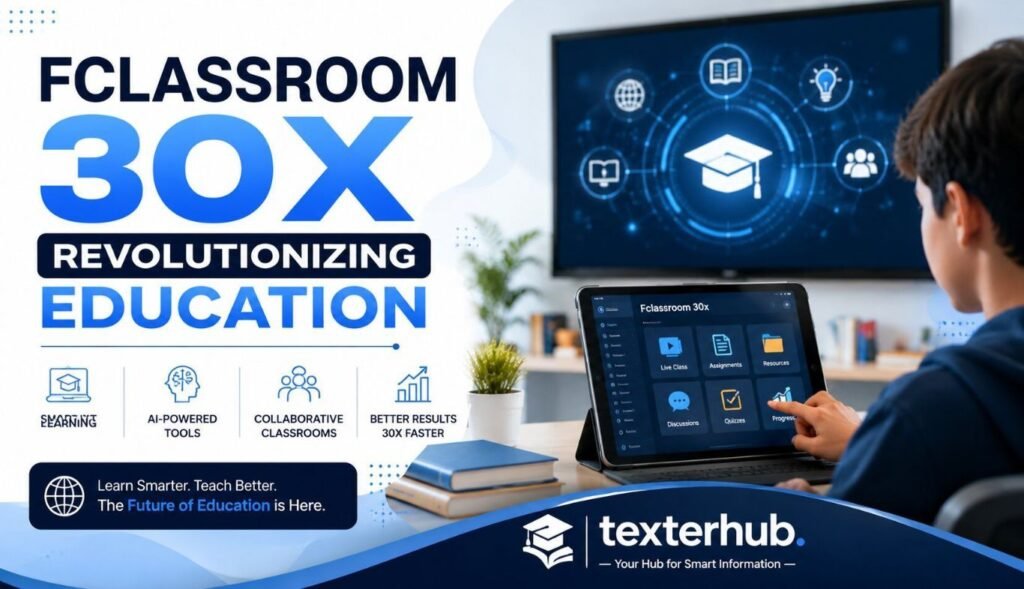

What Is Classroom 30x?
Fclassroom 30x revolutionizing education is a term that has been circulating across the educational technology world to describe a new generation of learning platforms built around artificial intelligence, cloud infrastructure, and real-time feedback. Fclassroom 30x revolutionizing education It isn’t a single rigid product so much as a model — a way of describing what a fully connected, AI-assisted smart classroom technology setup looks like when every piece works together instead of sitting in separate apps.
The “30x” in the name is meant to represent exponential improvement rather than a literal multiplier. It’s shorthand for the idea that when you combine a strong learning management system, adaptive content, and constant data feedback, the gains in engagement and outcomes compound quickly. Fclassroom 30x revolutionizing education Whether you’re a teacher exploring new education software or a parent trying to understand what your child’s school is adopting, the core idea is the same: learning that adjusts to the student instead of forcing the student to adjust to a fixed pace.
How Does Classroom 30x Work?
At its foundation, Classroom 30x works by collecting ongoing data on how a student interacts with material — how long they spend on a question, where they get stuck, which topics they breeze through — and feeding that data into an adaptive engine. Fclassroom 30x revolutionizing education The system then adjusts what comes next, offering extra practice where it’s needed and moving faster where a student has already shown mastery.
This is different from a static online learning platform that simply delivers the same worksheet to every student regardless of skill level. Fclassroom 30x revolutionizing education A cloud-based learning system tied into this kind of model can update recommendations in real time, meaning a teacher glancing at a dashboard mid-lesson can already see who needs a nudge and who’s ready for something harder.
Teachers still drive the classroom. The technology is there to remove guesswork, not replace judgment. A teacher using this kind of AI learning assistant typically spends less time manually grading quizzes and more time actually working with students who are struggling, because the system has already flagged where the gaps are.
Classroom 30x Revolutionizing Education
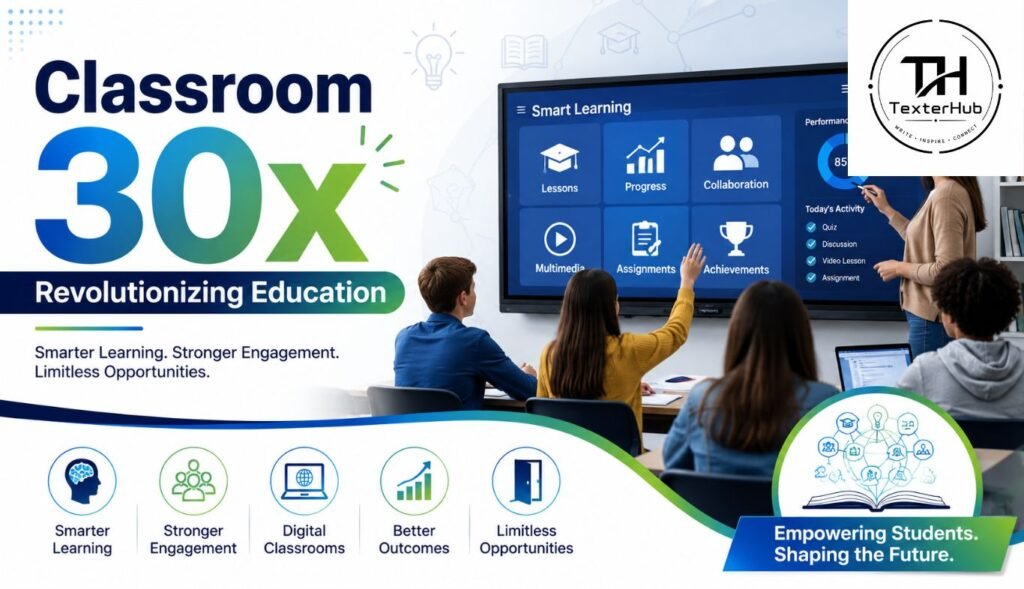
It’s fair to ask whether any of this is really a revolution or just another buzzword. The honest answer sits somewhere in between. Classroom 30x revolutionizing education isn’t about replacing teachers or turning school into something unrecognizable. It’s about closing a gap that’s existed for decades — the gap between a classroom of thirty students and a teacher who can only give focused attention to one at a time.
Traditional classrooms weren’t built for individual pacing. A textbook doesn’t know if a student read the same paragraph three times and still didn’t understand it. Fclassroom 30x revolutionizing education Digital transformation in education changes that by giving every student a feedback loop that used to only exist in one-on-one tutoring. That’s the actual shift happening here — not flashy gadgets, but a quieter change in how quickly a struggling student gets noticed.
Classroom 30x Digital Learning Platform Explained
Describing this as a Classroom 30x digital learning platform is useful shorthand, but it helps to break down what’s actually inside it. Most implementations combine four layers: a content library, an assessment engine, a communication layer for teachers and parents, and an analytics dashboard that ties it all together.
The content library holds lessons, videos, and practice sets aligned to a curriculum. The assessment engine decides what a student sees next based on performance. Fclassroom 30x revolutionizing education The communication layer keeps parents in the loop without requiring a phone call home. And the analytics dashboard gives school administrators a bird’s-eye view of how an entire grade level is performing, not just one classroom.
None of these pieces are new by themselves. What’s changed is how tightly they’re stitched together, and how much of the manual work between them has been automated.
Benefits of Classroom 30x
The benefits of Classroom 30x show up differently depending on who’s using it. Fclassroom 30x revolutionizing education For students, it usually means fewer moments of feeling completely lost, because the material adjusts before frustration sets in. For teachers, it means less time buried in paperwork and more time actually teaching.
Administrators tend to value it for a different reason: visibility. Fclassroom 30x revolutionizing education When performance data is centralized, it’s much easier to spot a school-wide trend — say, a dip in reading comprehension scores in third grade — before it becomes a crisis. That kind of early signal used to take a full semester of report cards to notice.
Parents benefit too, mostly through transparency. Instead of waiting for a quarterly report card, many of these platforms give parents a running view of assignments completed, scores, and areas needing attention.
Features of Fclassroom 30x
When people list out the features of Fclassroom 30x style platforms, a few keep showing up consistently. Adaptive quizzes that adjust difficulty in real time. Fclassroom 30x revolutionizing education Built-in messaging so teachers and parents don’t need a separate email thread. Automated attendance and basic grading. Virtual whiteboards for live sessions. And dashboards that turn raw activity logs into something a teacher can actually read at a glance between classes.
Some versions also include gamified elements — badges, streaks, small rewards for consistency — aimed at keeping younger students motivated without turning every lesson into a game show. Fclassroom 30x revolutionizing education Used carefully, this kind of light gamification helps with student engagement without becoming a distraction from the actual material.
AI-Powered Classroom Technology
AI in education gets a lot of hype, and it’s worth being specific about what it’s actually doing here. It isn’t writing lesson plans out of thin air or replacing curriculum design. Fclassroom 30x revolutionizing education What it’s doing well is pattern recognition — noticing, faster than a human grading forty papers a night could, that a particular type of math error keeps repeating across a class.
This kind of AI-powered classroom technology works best as an early-warning system. It flags things for a teacher to look at; it doesn’t make final calls about a student’s abilities. Fclassroom 30x revolutionizing education The platforms that get this balance right tend to keep a human reviewing anything that affects grades or placement decisions, with AI serving as the first pass rather than the last word.
Online Classroom Management
Running a classroom online brings its own headaches — attendance, muted mics, assignments that mysteriously vanish into the void. Good online classroom management tools handle the logistics so the actual teaching doesn’t get lost in tech troubleshooting.
This usually includes scheduling tools, automatic reminders for upcoming assignments, and a single place where students submit work instead of scattering it across email and file-sharing links. Fclassroom 30x revolutionizing education For a virtual classroom to function well, the administrative friction has to be close to zero, or teachers end up spending their prep time fighting software instead of planning lessons.
Interactive Education Platform Elements
An interactive education platform earns that label by making the student an active participant rather than someone watching a recorded lecture. Live polls during a lesson, collaborative documents where a whole class edits together, and breakout discussion rooms all fall into this category.
The goal isn’t novelty for its own sake. Research on attention spans consistently shows that passive listening drops off sharply after ten or fifteen minutes. Fclassroom 30x revolutionizing education Breaking a lesson into shorter interactive segments — a short explanation, then a quick check-in, then a discussion — keeps students from mentally checking out halfway through class.
Virtual Learning Experience
A strong virtual learning experience tries to replicate what’s good about an in-person classroom while accepting that some things simply work differently online. Fclassroom 30x revolutionizing education Eye contact and hallway conversations don’t translate. But small-group breakout rooms, shared digital whiteboards, and instant polling can actually outperform a physical classroom in certain situations, especially for shy students who rarely raise a hand in person but will type a question into a chat box.
The best implementations don’t try to force every online interaction to mimic an in-person one. They lean into what works uniquely well in a digital setting, like asynchronous discussion threads that let a student think through an answer instead of being put on the spot.
Digital Classroom Solutions
Digital classroom solutions cover a wide range, from simple video-conferencing add-ons to fully integrated systems that handle everything from enrollment to report cards. Fclassroom 30x revolutionizing education Schools adopting these tools usually start small — maybe just a shared calendar and assignment tracker — before expanding into more advanced features like adaptive testing.
That gradual rollout matters. Dropping an entire suite of new digital classroom tools on teachers overnight tends to backfire, since the learning curve for staff is just as real as the one for students. Schools that succeed with this kind of transition usually spend real time on training before expecting results.
Personalized Education Technology
Personalized learning sounds great in theory, and it genuinely helps when done well. The tricky part is that “personalized” can mean very different things depending on the subject. Fclassroom 30x revolutionizing education In math, it might mean adjusting problem difficulty. In writing, it might mean offering different examples based on a student’s interests, since a kid who loves basketball will engage more with an essay prompt about sports statistics than one about unrelated topics.
Good personalized education technology treats these as separate problems rather than applying one blanket algorithm across every subject. That nuance is often what separates a platform that genuinely helps from one that just feels like a fancier version of the same worksheet.
Cloud-Based Education Platform Advantages
Storing everything on a cloud-based education platform solves a practical problem schools have dealt with for years: a student who’s out sick doesn’t fall behind on paperwork sitting on a desk at home. Fclassroom 30x revolutionizing education Assignments, grades, and class materials are all reachable from any device with an internet connection.
This also makes life easier for families that move between school districts or deal with unpredictable schedules, since records don’t depend on a single physical location. The tradeoff is that schools need to take data privacy seriously, since student records living in the cloud raise real questions about who has access and how long that data is kept.
Smart Education Tools
Smart education tools typically refer to hardware and software working in tandem — interactive whiteboards connected to a lesson plan, tablets synced with a teacher’s dashboard, or sensors that track how long a student has been active on an assignment. None of this replaces good teaching, but it removes some of the manual bookkeeping that eats into class time.
A teacher no longer has to manually record who submitted homework; the system does it automatically and flags anyone who hasn’t turned something in by the deadline. That single automation alone can save a teacher hours over the course of a semester.
Adaptive Learning in Practice
Adaptive learning is the engine behind most of what makes these systems feel personalized. Fclassroom 30x revolutionizing education Rather than a fixed sequence of lessons, the system reroutes a student based on performance — offering remedial content after a few wrong answers, or skipping ahead when a concept is clearly already understood.
This only works well when the underlying content library is deep enough to have multiple paths through a topic. Fclassroom 30x revolutionizing education A thin content library with adaptive branding slapped on top doesn’t actually adapt to much; it just shuffles between two or three difficulty tiers. The quality of the underlying material still matters more than the algorithm wrapped around it.
Learning Management System Integration
Most schools already run some kind of learning management system, and a new platform succeeds or fails based on how well it plugs into what’s already there. Fclassroom 30x revolutionizing education Nobody wants to maintain three separate logins for grading, attendance, and assignments.
Good integration means grades sync automatically, single sign-on works across tools, and a teacher isn’t manually copying data from one system into another every week. Fcla ssroom 30x revolutionizing educationThis is a less glamorous part of education innovation, but it’s usually the deciding factor in whether staff actually adopt a new tool or quietly go back to spreadsheets.
Blended and Hybrid Learning Models
Blended learning and hybrid education get used almost interchangeably, though there’s a subtle difference. Blended learning usually means combining in-person instruction with online components for the same group of students. Hybrid education often refers to some students attending in person while others join remotely at the same time.
Both models rely heavily on the same underlying techno logy — recorded lessons, shared documents, synchronous video tools — but they solve different problems. Fclassroom 30x revolutionizing educationBlended learning is about flexibility within a single classroom. Hybrid learning is about access for students who can’t physically be present, whether due to illness, distance, or other circumstances.
Remote Learning Capabilities
Remote learning became a household term out of necessity a few years back, and while the urgency has faded, the infrastructure built during that period didn’t disappear. Fclassroom 30x revolutionizing education Schools that invested in solid remote education technology found it useful well beyond emergency closures — for snow days, for students recovering from illness, or for rural districts where a specialist teacher can only be in one building at a time.
The lesson many schools learned the hard way is that remote learning works best as a deliberate design choice, not a last-minute scramble. Platforms built with remote access in mind from the start tend to hold up far better than ones retrofitted under pressure.
Student Engagement Strategies
Keeping attention in any classroom, physical or digital, comes down to a handful of consistent principles. Short segments beat long lectures. Immediate feedback beats waiting a week for a graded paper. Fclassroom 30x revolutionizing education And a sense of visible progress — even something as simple as a completion bar — keeps students motivated to finish what they start.
Classroom engagement strategies built into these platforms usually lean on these same basics rather than anything exotic. Fclassroom 30x revolutionizing education The technology just makes it easier to apply them consistently across every lesson instead of relying on one teacher’s individual style.
Teacher Productivity and Collaboration
Teacher productivity improves most noticeably in the areas nobody enjoys doing manually — grading multiple-choice sections, tracking attendance, chasing down missing assignments. Fclassroom 30x revolutionizing education Automating these frees up time for the parts of teaching that actually require a human: explaining a tricky concept a different way, or noticing a student who seems off that day.
A teacher collaboration platform built into the system also matters more than people expect. Teachers sharing lesson plans and quiz banks across a department cuts down on duplicated work, especially for new teachers building their first year of materials from scratch.
Classroom Automation
Classroom automation covers the small, repetitive tasks that add up over a school year — sending reminder emails, generating progress reports, flagging late assignments. Fclassroom 30x revolutionizing education None of it is exciting, but the cumulative time saved is real.
The risk worth mentioning is over-automating the parts of teaching that genuinely need a human touch, like feedback on an essay. Automated grammar checks are useful, but a student’s growth as a writer still depends on a teacher reading their actual argument, not just their sentence structure.
Learning Analytics Tools
Learning analytics tools turn raw activity data — time spent, questions answered, topics revisited — into something a teacher can act on. A dashboard showing that half the class struggled with the same question is far more useful than forty individual quiz papers sitting in a stack.
Used well, this kind of data helps a teacher adjust the next day’s lesson instead of waiting until the end of a unit to realize something didn’t land. Used poorly, it turns into noise — too many metrics, not enough clarity on what actually matters. Platforms that succeed here tend to surface just a handful of key indicators instead of overwhelming a teacher’s dashboard.
Digital Teaching Resources
A deep library of digital teaching resources — video explainers, practice sets, reference sheets — gives teachers options without requiring them to build everything from scratch. This matters especially for smaller schools that don’t have a large curriculum department to lean on.
The best resource libraries are searchable by standard, grade level, and skill, so a teacher can find exactly what’s needed for tomorrow’s lesson in a few minutes rather than digging through folders.
Education Technology Trends
Looking at broader education technology trends, a few patterns keep showing up: more emphasis on data privacy regulation, growing interest in offline-capable tools for areas with unreliable internet, and a slow move away from one-size-fits-all software toward modular systems schools can customize.
There’s also a growing awareness that technology adoption needs to be paired with teacher training. Fclassroom 30x revolutionizing education A school that buys a strong platform but skips staff training usually sees underwhelming results, not because the tool failed, but because nobody was shown how to use it well.
Future of Online Learning
The future of education likely won’t look like a dramatic overnight shift so much as a gradual layering of tools that quietly become normal. Just as calculators eventually stopped being controversial in math class, adaptive software is heading toward being an unremarkable part of daily instruction rather than a headline feature.
The future of online learning probably includes more offline functionality, tighter integration between school and home, and continued refinement of how AI flags struggling students without replacing a teacher’s judgment about what a student actually needs.
Innovative Classroom Software Considerations
Not every school needs every feature available in innovative classroom software. Fclassroom 30x revolutionizing education A rural elementary school with limited internet access has very different needs than a large urban high school running dozens of electives. Choosing a platform should start with the specific problems a school is trying to solve, not a checklist of trendy features.
Cost is also a real factor that often gets glossed over in marketing materials. Fclassroom 30x revolutionizing education Subscription pricing, training time, and IT support all add up, and a school district evaluating educational software for schools should budget for the full cost of adoption, not just the license fee.
Student-Centered Learning
At the heart of all this is a simple principle: student-centered learning puts the student’s pace and needs ahead of a fixed curriculum schedule. That’s not a new idea — good teachers have tried to do this for generations, often without the tools to make it practical for a room of thirty kids.
What’s changed is the ability to actually deliver on that principle at scale, without requiring a teacher to somehow individually track thirty different learning paths in their head. The technology is a means to an end, not the point itself.
Challenges Worth Considering
None of this comes without tradeoffs. Screen time concerns are real, especially for younger students. Data privacy is a legitimate worry when student records live on cloud servers. Fclassroom 30x revolutionizing education And there’s a genuine risk of over-reliance on automated grading for subjects like writing, where nuance matters more than a checklist.
Equity is another concern that deserves honest attention. A smart learning environment only works if students actually have reliable devices and internet access at home. Schools rolling out these tools need a plan for students who don’t, or the gap between students widens instead of closing.
Who Is Behind Classroom 30x?
Because Classroom 30x functions more as an industry term than a single trademarked company, there isn’t one public founder, headquarters, or financial figure to report on. Fclassroom 30x revolutionizing education Different websites use the name to describe similar concepts in modern education systems, which is why you’ll find slightly different explanations depending on the source. Fclassroom 30x revolutionizing education If a specific vendor markets itself under this name in your region, it’s worth checking that company’s own official site directly for verified details about its team and pricing, rather than relying on secondhand summaries.
FAQs
Is Classroom 30x a real product or a concept? It’s largely used as a descriptive concept for AI-driven, adaptive classroom platforms rather than one single branded product, though various companies market similar tools under related names.
Does it replace teachers? No. Fclassroom 30x revolutionizing education It’s designed to reduce administrative workload and flag where students need help, leaving instructional decisions to the teacher.
Is it suitable for younger students? Most implementations are built with age-appropriate content controls, though screen-time guidelines still matter for younger age groups regardless of the platform.
What does it cost? Pricing varies widely by vendor and school size, so it’s best to request a direct quote from whichever specific platform a school is considering.
Final Thoughts
Classroom 30x, as a concept, represents something worth paying attention to — not because of the name itself, but because of what it points toward: classrooms where a struggling student gets noticed in days instead of months, and where a teacher’s time goes toward actual teaching instead of paperwork. Fclassroom 30x revolutionizing education Like any tool, its value depends entirely on thoughtful implementation, proper training, and keeping the focus on students rather than the software itself.