

Introduction
Every industry is talking about digital transformation right now, and one phrase that keeps surfacing in that conversation is Digital Infusing Aggr8Tech. It is not a single app or a single company product — it is better understood as an approach, a way of thinking about how technology gets woven into the daily work of a business rather than bolted on as an afterthought.
Over the past few years, business digitalization has moved from being a nice-to-have to being the baseline expectation for staying competitive. Customers expect faster replies, smoother checkouts, and personalized service. Employees expect tools that actually save them time instead of adding more clicks to their day. Digital Infusing Aggr8Tech sits right at that intersection, describing how organizations blend enterprise technology into their existing structure without tearing everything down and starting over.
This article walks through what the term actually means, how it works in practice, what tools sit underneath it, and how different types of businesses are applying it. The goal is to give you a grounded, practical picture rather than another recycled definition.
It is also worth being upfront about something: this is a fairly new phrase, and different sources describe it in slightly different ways. Rather than treating any single definition as gospel, the most useful approach is to focus on the underlying pattern — connecting digital tools, data, and processes so a business runs more smoothly — and judge any specific tool or platform against how well it actually delivers that outcome for your own team.
What Is Digital Infusing Aggr8Tech
At its core, what is Digital Infusing Aggr8Tech comes down to one idea: taking digital tools and quietly embedding them into the parts of a business that already run every day — sales, support, operations, finance — instead of treating technology as a separate project.
Rather than a “rip and replace” overhaul, it favors a gradual, layered approach. A support team might start by adding one automated workflow. A finance team might connect one reporting dashboard to live data. Over time, these small additions build into something bigger.
This is different from a typical digital innovation initiative that announces a big bang launch. It is closer to renovation than demolition — improving a house room by room while people still live in it.
Digital Infusing Aggr8Tech Explained
To break it down further, Digital Infusing Aggr8Tech explained in simple terms means combining several layers of technology — data, automation, and intelligence — so they work together instead of sitting in separate silos.
Think of a company where the sales team uses one system, marketing uses another, and support uses a third, and none of them talk to each other. That is the opposite of infusion. The point of this approach is to connect those systems so information flows automatically between them.
When done properly, this connects smart business solutions across departments so a customer’s history, preferences, and open tickets are visible in one place instead of scattered across five different logins.
How Digital Infusing Aggr8Tech Works
Understanding how Digital Infusing Aggr8Tech works starts with three basic layers: data collection, processing, and action. Data comes in from everyday activity — website visits, purchases, support tickets, inventory counts.
That data then passes through processing tools, which might include artificial intelligence in business models or simpler rule-based systems, depending on the complexity of the task. This is where raw numbers turn into something a manager can actually use.
Finally, the action layer triggers a response — an automated email, an inventory reorder, a flagged support ticket, or an updated dashboard. The entire loop can run in seconds, which is a big shift from teams manually checking spreadsheets once a week.
This layered structure is why many people describe it using the language of intelligent automation — it is not just automation for its own sake, it is automation guided by data and context.
A Practical Digital Infusing Aggr8Tech Guide
For anyone starting from zero, a simple Digital Infusing Aggr8Tech guide usually follows four stages: assess, prioritize, pilot, and scale.
The assessment stage means looking honestly at where time is being wasted. Which tasks are still manual? Where do employees copy data from one system into another by hand? These pain points are usually the best starting place.
Prioritization means picking one or two processes that would benefit the most, rather than trying to fix everything simultaneously. A small pilot project, run over a few weeks, gives a business real evidence of whether the approach works before committing bigger budgets.
Once a pilot proves useful, scaling means expanding the same pattern to other departments. This staged path keeps risk low and keeps staff from feeling overwhelmed by sudden change.
Core Digital Infusing Aggr8Tech Features
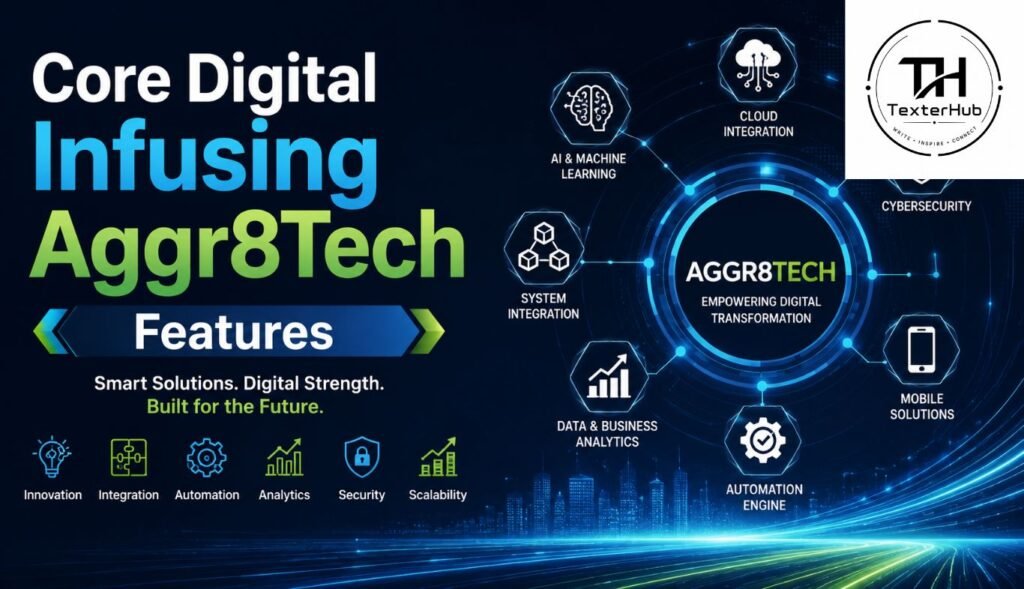
Several Digital Infusing Aggr8Tech features tend to show up across most implementations, regardless of industry. The first is connectivity — the ability for different software tools to share information without manual re-entry.
The second is visibility, usually delivered through dashboards that pull live numbers instead of static reports. Managers can see order volume, support wait times, or production output as it happens rather than waiting for a weekly summary.
The third is adaptability. Good systems are built in modules, so a business can add or remove a piece without disrupting everything else. This modularity is part of what separates a thoughtful digital strategy from a rushed software purchase.
The fourth is security, since connecting more systems also means more entry points that need protection — a topic covered in more depth later in this guide.
Digital Infusing Aggr8Tech Benefits
The most commonly cited Digital Infusing Aggr8Tech benefits include time savings, fewer errors, and better decision-making. When repetitive tasks are automated, staff spend less time on data entry and more time on work that actually needs human judgment.
Fewer errors follow naturally, since manual copying and pasting is one of the biggest sources of mistakes in daily business operations. A connected system reduces the chances of a customer’s address being wrong in one place and right in another.
Better decision-making comes from having accurate, current information available when it is needed, rather than digging through old spreadsheets. This ties closely into business intelligence, where leaders use live data rather than gut feeling to plan next steps.
There is also a quieter benefit: employee satisfaction. Fewer repetitive tasks generally means less burnout, and teams that trust their tools tend to stick around longer.
The Digital Infusing Aggr8Tech Technology Stack
Every approach needs a foundation, and the Digital Infusing Aggr8Tech technology stack typically includes a mix of cloud computing solutions, automation tools, and analytics platforms.
Cloud infrastructure matters because it allows systems to be accessed from anywhere and scaled up or down as needed, without a company needing to own and maintain physical servers. This is part of why cloud-based platforms have become the default choice for most modern software rollouts.
On top of the cloud layer sits automation software, which handles repetitive tasks like sending confirmation emails, updating spreadsheets, or routing support tickets. Above that sits the analytics layer, which turns collected data into charts, alerts, and forecasts that people can act on.
Security tools run underneath all of it, monitoring for unusual activity and protecting sensitive data as it moves between systems — an increasingly important part of any digital infrastructure conversation.
Digital Infusing Aggr8Tech Business Solutions
When applied practically, Digital Infusing Aggr8Tech business solutions tend to cluster around a few common problems: slow customer response times, disconnected inventory tracking, and manual reporting.
For customer response, a connected system can route incoming messages to the right team automatically, based on keywords or urgency, cutting down wait times significantly. This directly touches digital customer experience, since faster, more accurate replies are one of the biggest drivers of customer satisfaction today.
For inventory, connecting point-of-sale data with warehouse systems means stock counts update automatically instead of requiring someone to walk the floor and count by hand. This reduces both overstocking and stockouts.
For reporting, dashboards replace the monthly scramble to pull numbers from five different spreadsheets, saving hours of staff time every reporting cycle.
Digital Infusing Aggr8Tech and Digital Transformation
It helps to place Digital Infusing Aggr8Tech digital transformation in context. Broader digital transformation is the big-picture shift — a company deciding, at a leadership level, to become more technology-driven across the board.
Infusion is one practical way to carry that decision out without a massive, disruptive rollout. Instead of a five-year master plan that risks becoming outdated before it finishes, infusion works in shorter cycles, testing and adjusting as it goes.
This matters because many large transformation projects stall or run over budget when they try to change everything at once. A more incremental approach tends to keep momentum, since teams see results faster and stay motivated to continue.
Digital Infusing Aggr8Tech Automation
Digital Infusing Aggr8Tech automation covers everything from simple rule-based triggers to more advanced systems that adjust based on patterns in the data.
A simple example is an automatic reminder email sent when an invoice is overdue. A more advanced example is a system that predicts which invoices are likely to go unpaid based on a customer’s past behavior, flagging them earlier so a team can follow up before it becomes a problem.
This ties closely into workflow automation, since the goal is not just to automate isolated tasks but to automate entire sequences of steps that used to require several people checking in at different points.
Business process automation more broadly covers this shift — moving repetitive, rule-based work off human plates so people can focus on judgment calls, relationship building, and problem-solving that machines still cannot replicate well.
Digital Infusing Aggr8Tech AI Integration
Digital Infusing Aggr8Tech AI integration adds a layer of learning on top of basic automation. Where automation follows fixed rules, AI adjusts based on patterns it has seen before.
Machine learning applications are common in this space — for example, a system that learns which support tickets are usually urgent based on wording and past resolution times, then prioritizes similar tickets automatically going forward.
Predictive analytics is another piece of this puzzle, used to forecast demand, flag potential equipment failures before they happen, or estimate which customers are at risk of leaving. None of this requires a company to build its own AI from scratch — most of it comes through existing software that already has these features built in.
The key is that AI here is meant to support decisions, not replace human oversight entirely. A well-designed system flags something unusual and lets a person make the final call, rather than acting completely on its own in high-stakes situations.
Digital Infusing Aggr8Tech Cloud Computing
Cloud infrastructure is one of the quieter but most important pieces of this whole picture. Digital Infusing Aggr8Tech cloud computing allows different tools to connect and share data without needing physical servers sitting in an office closet.
This matters for smaller businesses especially, since cloud tools usually come with lower upfront costs — a monthly subscription instead of an expensive server purchase. It also matters for larger businesses because cloud systems can scale up during busy seasons and scale back down afterward.
Software integration between cloud tools is typically handled through APIs, which act as the connectors letting one piece of software talk to another. A well-built stack of connected business systems means a customer’s order, shipping status, and support history all update in real time across every tool that needs to see them.
Digital Infusing Aggr8Tech Workflow Automation
Zooming into workflows specifically, Digital Infusing Aggr8Tech workflow automation focuses on the step-by-step sequences that make up daily operations rather than single isolated tasks.
A hiring workflow is a good example. Instead of a recruiter manually emailing every candidate, scheduling every interview, and updating a spreadsheet by hand, a connected system can send automatic confirmations, sync interview times to calendars, and update candidate status without anyone touching a keyboard for routine steps.
These digital workflows free up recruiters, accountants, and support staff to spend time on the parts of their job that genuinely need a human — building relationships, solving unusual problems, and making judgment calls.
Digital Infusing Aggr8Tech Use Cases
Looking at real Digital Infusing Aggr8Tech use cases helps make the concept less abstract. In retail, connected systems link online and in-store inventory so a customer can check stock accurately before visiting a location.
In healthcare, appointment scheduling, patient records, and billing can be connected so staff are not manually re-entering the same patient information into three different systems.
In manufacturing, sensors on equipment feed data into monitoring dashboards, flagging maintenance needs before a breakdown happens rather than after production stops.
In finance, connected reporting tools pull numbers automatically from banking, payroll, and expense systems, cutting down the time spent preparing monthly statements.
Digital Infusing Aggr8Tech Applications
Beyond specific use cases, the broader Digital Infusing Aggr8Tech applications span customer service, human resources, supply chain management, and marketing.
In customer service, chatbots and automated ticket routing handle the simple, repetitive questions, freeing human agents for complex issues that need patience and problem-solving.
In human resources, onboarding paperwork, benefits enrollment, and performance tracking can move through connected systems instead of paper forms and manual spreadsheets.
In supply chain management, real-time tracking connects suppliers, warehouses, and delivery partners so a delay at one point in the chain gets flagged immediately rather than discovered days later.
In marketing, connected data means campaigns can be personalized based on actual customer behavior instead of broad guesses about what an audience wants.
Digital Infusing Aggr8Tech for Enterprises
Larger organizations face a different set of challenges than smaller ones, and Digital Infusing Aggr8Tech for enterprises usually centers on connecting legacy systems that have been in place for years, sometimes decades.
Older systems were often built before cloud tools existed, so connecting them requires extra planning — sometimes through middleware that acts as a translator between old and new software. This is where enterprise automation and enterprise software solutions come into play, offering pre-built connectors designed specifically for this kind of legacy integration.
For enterprises, security and compliance also carry heavier weight, since larger organizations typically handle more sensitive data and face stricter regulatory requirements. Any infusion strategy at this scale needs a clear plan for cybersecurity solutions built in from the start, not added later as an afterthought.
Digital Infusing Aggr8Tech for Small Businesses
Smaller companies approach this differently, and Digital Infusing Aggr8Tech for small businesses tends to favor affordable, ready-made tools over custom-built systems.
A small business does not usually need a massive infrastructure project. Instead, connecting a handful of everyday tools — accounting software, an online store, a scheduling app — often delivers most of the benefit at a fraction of the cost.
This is where business scalability becomes relevant. A small business that sets up connected systems early tends to grow more smoothly than one that waits until manual processes are already breaking under the pressure of increased order volume or customer demand.
Cost is naturally a bigger factor for smaller teams, so most start with free or low-cost tools that already offer built-in integrations, rather than paying for custom development from day one.
Digital Infusing Aggr8Tech Platform Considerations
Choosing the right Digital Infusing Aggr8Tech platform depends heavily on what a business already uses. Switching every existing tool at once is rarely realistic, so most businesses look for platforms that connect with what they already have.
A good platform should support the tools a team already relies on, offer clear reporting, and be flexible enough to add new features later without a complete rebuild. It should also come with reasonable support, since even simple integrations can run into unexpected issues.
Pricing structure matters too — some platforms charge per user, others per volume of data processed, and understanding which model fits a business’s actual usage pattern can prevent unpleasant billing surprises down the line.
Digital Infusing Aggr8Tech Software Options
There is no single piece of Digital Infusing Aggr8Tech software that fits every business. Instead, most companies combine several specialized tools rather than relying on one all-in-one system.
Customer relationship management software handles the sales and support side. Accounting software handles the financial side. Project management tools handle internal coordination. The infusion happens when these separate tools are connected so information passes between them automatically.
This modular approach avoids the risk of being locked into a single vendor, while still gaining most of the benefits of a fully connected system.
Digital Infusing Aggr8Tech Digital Ecosystem
A well-built Digital Infusing Aggr8Tech digital ecosystem functions almost like a nervous system for a business — each part sending and receiving signals so the whole organization can respond quickly to change.
This kind of digital ecosystem typically includes customer-facing tools, internal operations software, and the analytics layer that ties everything together. When one part of the ecosystem detects a shift — say, a sudden spike in orders — that information can trigger automatic adjustments elsewhere, like alerting the warehouse team or adjusting marketing spend.
Building this kind of ecosystem takes time, and most businesses get there gradually rather than all at once, adding new connections as specific needs come up.
Digital Infusing Aggr8Tech Business Innovation
Beyond efficiency, there is a creative side to this approach. Digital Infusing Aggr8Tech business innovation often comes from the extra time and clearer data that connected systems free up.
When staff are not stuck doing manual data entry, they have more room to think about new products, better customer experiences, or smarter ways of doing things. When leadership has clear, live data instead of outdated reports, they can spot opportunities faster than competitors who are still working from last month’s numbers.
This connects to innovation management more broadly — the practice of organizing how new ideas get tested and rolled out within a business, rather than leaving innovation to chance.
Digital Infusing Aggr8Tech Data Analytics
Digital Infusing Aggr8Tech data analytics turns raw numbers into something people can actually use day to day. This includes everything from simple sales dashboards to more advanced forecasting tools.
Good data analytics setups usually start simple — tracking basic metrics like order volume or response time — before adding more advanced layers like customer segmentation or trend forecasting. Trying to build an advanced analytics system before the basics are solid usually leads to confusion rather than clarity.
Over time, as more data accumulates, patterns become clearer, and predictions become more reliable. This is part of why starting early, even with a small pilot, tends to pay off later.
Digital Infusing Aggr8Tech Process Optimization
Digital Infusing Aggr8Tech process optimization is about refining how work actually flows through a business, not just adding new tools on top of old habits.
Process optimization starts by mapping out how a task currently gets done, step by step, before deciding what to automate or connect. Skipping this mapping stage is one of the most common mistakes businesses make — automating a broken process just makes the broken process run faster.
Once a process is clearly mapped, it becomes obvious where the bottlenecks are, and those bottlenecks are usually the best starting points for connecting systems or automating steps.
Digital Infusing Aggr8Tech Operational Efficiency
The end goal for most businesses adopting this approach is operational efficiency — getting more done with the same or fewer resources, without burning out staff in the process.
Digital Infusing Aggr8Tech operational efficiency shows up in measurable ways: shorter response times, fewer manual errors, faster reporting cycles, and lower overhead costs. These improvements tend to compound over time, since each connected process frees up time and attention for the next improvement.
It is worth noting that efficiency gains are rarely instant. Most businesses see modest early wins that grow larger as more of the organization becomes connected and staff become more comfortable with the new tools.
Digital Infusing Aggr8Tech Implementation
A realistic Digital Infusing Aggr8Tech implementation plan usually spans a few months rather than a few weeks, even for a relatively small pilot project.
The first stage involves mapping existing processes and identifying which tools are already in use. The second stage involves selecting the right platform or combination of tools based on that mapping. The third stage is the actual rollout, usually starting with one team or one process before expanding further.
Technology adoption across a team rarely happens instantly, so training and support during this stage matter just as much as the technical setup itself. Staff who understand why a new tool exists, and how it makes their job easier, adopt it far more readily than staff who feel it was forced on them without explanation.
Digital Infusing Aggr8Tech Examples
A few grounded Digital Infusing Aggr8Tech examples help illustrate how this plays out in practice. A small online retailer connecting its store platform to its accounting software so sales automatically update financial records is a simple but effective example.
A mid-sized logistics company linking delivery tracking with customer notifications, so customers get automatic updates without staff manually sending emails, is another common example.
A healthcare clinic connecting appointment scheduling with reminder texts, cutting down on missed appointments without adding extra staff workload, shows the same pattern applied to a service-based business.
In each case, the pattern is the same: connect existing systems, automate the repetitive parts, and free up staff time for higher-value work.
Digital Infusing Aggr8Tech Future Trends
Looking ahead, several Digital Infusing Aggr8Tech future trends are worth watching. The continued growth of Internet of Things (IoT) devices means more physical equipment — from delivery vehicles to factory machines — will feed live data into business systems.
Artificial intelligence tools are also becoming more accessible to smaller businesses, not just large enterprises with dedicated tech teams. This is gradually leveling the playing field, letting smaller companies use tools that were once reserved for corporations with big budgets.
Business technology trends also point toward tighter security requirements, as more connected systems mean more potential entry points for bad actors. Businesses that build strong security practices in early will likely face fewer headaches as their systems grow more complex.
Digital collaboration tools are also expected to keep improving, especially for teams working across different locations, making it easier to coordinate work without everyone being in the same building.
Digital Infusing Aggr8Tech Business Growth
Ultimately, the reason this approach matters comes down to Digital Infusing Aggr8Tech business growth — the practical, measurable impact on a company’s ability to serve more customers without a proportional increase in cost or headcount.
Connected systems mean a business can handle a larger volume of orders, tickets, or transactions with the same team size, since much of the routine work is handled automatically. This directly supports business productivity, since staff time gets redirected toward tasks that actually require human attention.
This kind of growth tends to be more sustainable than growth built purely on hiring more people to handle more manual work, since it does not carry the same rising overhead costs as a business scales.
Digital Infusing Aggr8Tech Technology Stack Security
Since this whole approach depends on connecting systems and sharing data between them, security cannot be an afterthought. Cybersecurity solutions need to be built into the stack from the earliest planning stages, not patched on after something goes wrong.
Basic practices matter here — strong access controls, regular software updates, and clear policies about who can see what data. Connected systems can be a real strength for a business, but only if the connections themselves are properly secured against unauthorized access.
Regular audits of who has access to which systems, and why, help catch gaps before they become serious problems. This is especially important as a business grows and more employees, contractors, or partners need some level of system access.
Digital Infusing Aggr8Tech Best Practices
To close things out, a few Digital Infusing Aggr8Tech best practices tend to separate successful implementations from frustrating ones.
Start small and prove value before expanding. A single successful pilot project builds trust and momentum for the next phase, while a rushed, company-wide rollout often creates confusion and resistance among staff.
Involve the people who will actually use the new tools early in the process. Staff who understand why a change is happening, and who had some say in how it works, tend to adopt new systems far more smoothly than those who feel it was imposed on them.
Keep security and data privacy part of the conversation from day one, not something addressed after a problem occurs. And finally, treat this as an ongoing practice rather than a one-time project — the businesses that get the most out of this approach keep refining and connecting new pieces over time rather than considering the job finished after the first rollout.
Digital Infusing Aggr8Tech Versus Traditional IT Upgrades
It helps to compare this approach against the way businesses used to handle technology upgrades. A traditional IT upgrade often meant picking a single large system, spending months planning it, and then switching everything over on one fixed date.
That approach carries real risk. If something goes wrong on launch day, an entire department can grind to a halt while the technical team scrambles to fix it. Staff also tend to resist sudden, sweeping changes, especially when they were not consulted beforehand.
Digital Infusing Aggr8Tech takes a noticeably different path. Instead of one big switch, it works through smaller, staged additions that can be tested, adjusted, and rolled back if something is not working, without putting the whole business at risk at once.
This staged approach also tends to be gentler on budgets. Rather than a single large upfront cost, spending gets spread out over time, and each stage can be justified by the results of the one before it. For many businesses, this practical, lower-risk pacing is the real appeal, more than any specific piece of technology involved.
Common Challenges in Digital Infusing Aggr8Tech
No approach is without friction, and it is worth being honest about the common challenges businesses run into. The first is resistance to change. Even well-designed tools can meet pushback if staff feel they were not consulted or trained properly beforehand.
The second challenge is data quality. Connecting systems only helps if the underlying data is accurate. If customer records are outdated or duplicated across different tools, connecting those systems just spreads the same errors faster instead of fixing them.
The third challenge involves legacy systems, particularly for larger, older organizations. Some older software was never built to share data with newer tools, and connecting it often requires extra middleware or custom development work that adds time and cost to a project.
The fourth challenge is simply knowing where to stop. It can be tempting to keep adding more automation and more connections indefinitely, but not every process benefits from it. Some tasks genuinely need a human’s judgment, and forcing automation onto them can create more problems than it solves.
Recognizing these challenges early, rather than being surprised by them mid-project, tends to make the difference between a smooth rollout and a frustrating one.
How to Measure Success
Once a business has started down this path, it helps to have a clear way of measuring whether it is actually working. Common measures include time saved on specific tasks, error rates before and after a change, and how quickly customer questions get resolved.
Financial measures matter too, particularly cost per transaction or cost per customer served, since a well-connected system should generally lower both over time. Employee feedback is another useful, if less numeric, signal — staff who feel their tools are helping them tend to say so fairly directly.
It is worth setting these measures before a pilot project begins, rather than after, so there is a clear baseline to compare against. Without a baseline, it becomes difficult to tell whether a new tool actually improved anything or whether results would have looked similar anyway.
FAQs
Is Digital Infusing Aggr8Tech only for large companies? No. While large enterprises often have more legacy systems to connect, smaller businesses can apply the same principles using affordable, ready-made tools, often with less complexity involved.
How long does an implementation usually take? It depends on scope, but a single pilot project connecting one or two processes can often be completed within a few weeks to a couple of months, while a company-wide rollout may take considerably longer.
Does this require an in-house technical team? Not necessarily. Many modern tools are designed for non-technical staff to configure, though larger or more complex integrations may benefit from outside technical support.
What is the biggest risk in getting this wrong? Automating a broken or poorly understood process is one of the most common mistakes, since it tends to make existing problems happen faster rather than fixing them.
Can this approach be reversed if it does not work out? Because it is usually rolled out in stages rather than all at once, individual pieces can typically be adjusted or rolled back without disrupting the entire business, which is one of its practical advantages.
Conclusion
Digital Infusing Aggr8Tech is best understood not as a single product but as a practical mindset — connecting the digital tools a business already uses so they work together instead of sitting in isolated silos. It draws on familiar building blocks: cloud computing, automation, data analytics, and artificial intelligence, applied gradually and thoughtfully rather than all at once.
For businesses of any size, the path usually starts the same way: map out where time is being wasted, pick one process to improve, prove it works, and then expand from there. Done this way, the shift toward a more connected, efficient way of working feels manageable rather than overwhelming — and the results, over time, tend to speak for themselves.